Apple Music Hall
I went to see Skye Newman at Apple Music Hall, Apple's new 600-capacity venue inside Battersea Power Station. Apple calls it intimate, and it truly is.

- Venue
- Apple Music Hall
- Where
- Battersea Power Station, London
- Visited
- 7 October 2026
- I saw
- Skye Newman
What does Apple mean by intimate?
Apple describes Apple Music Hall as a home for "bespoke, intimate performances", a venue "designed intentionally to close the gap between intimacy and production value" [1]. Plenty of venues call themselves intimate. Having stood in this one, I think Apple means something specific: you should feel the artist is performing for you, without giving up the sound, light and production you would expect from a much bigger show.
The numbers help. The hall holds 600 people and the stage is 38 feet (11.6 metres) wide [1], so you are always close to the performer. But the numbers don't explain the feeling.
Skye Newman was a perfect example of how close a venue like this lets you get. Fans at the front reached out to her and she reached back, holding hands and waving to people in the crowd. It felt like a one-to-one experience with the performer.
The crowd was made up of people from all walks of life, all there for the same music. That is what makes the intimacy special: it brings people together to share the joys of life. Music is one of the most powerful ways we have to express emotion, and so is the design of a space and the guest's journey through it. At Apple Music Hall the two work together.
London has been missing a venue like this, and it couldn't be in a better location.
The Apple customer journey
The intimacy starts long before the music. From the front of Battersea Power Station, along the temporary barriers and into the building, everyone working was wearing an Apple Music shirt, and everyone was lovely.
Every time I met a new member of the Apple Music team on the way in, I got the same warm welcome: "Welcome to Apple Music Hall. How are you doing today? Can I help you?" Everyone was helpful, kind and genuine, and it made the venue feel personal from the very first minute.
Having worked as a Specialist at Apple Regent Street, I recognised it straight away. This is the Apple retail customer journey, and it brings the best bits of it with it: a real connection with each person, carried all the way from the street to the stage.

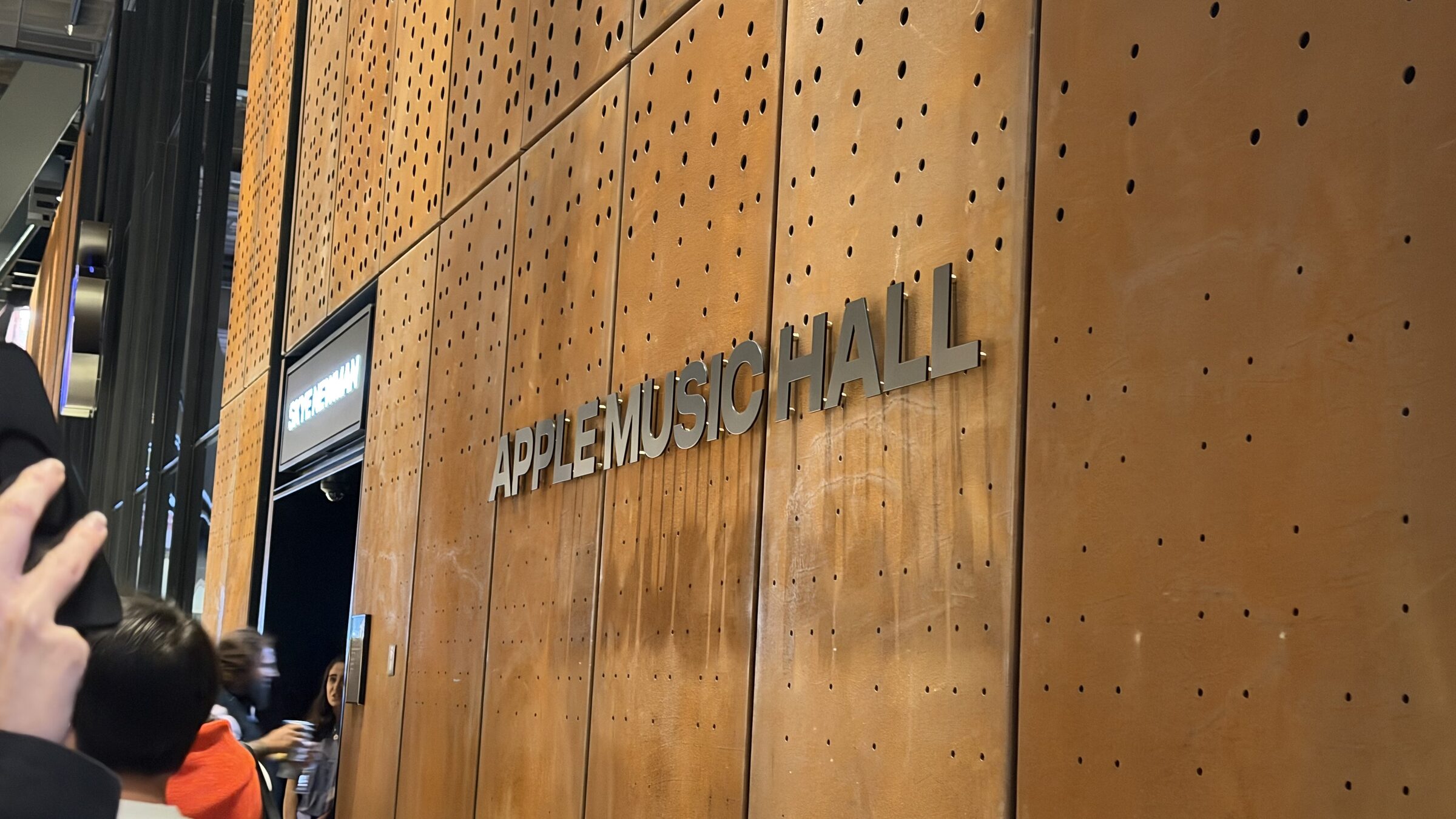
assets/photo-1.jpgApple, inside a power station
The space is cosy and a little rustic, and its colours are still industrial, a reminder of its past life as a power station. But it is truly Apple.
Apple Music Hall had to be retrofitted into Battersea Power Station, a Grade II* listed building. Apple says the design takes its cues from the station's heritage brickwork, fluted arches and bronze balconies [1].
Even so, everything in the venue is unmistakably Apple's design, and it is beautiful. The curves follow the same radii as Apple's products, and every fillet matches the fillets on the devices. It is the design language Jony Ive developed, and it has stayed timeless ever since. Every little detail has been considered.
Textures and colours
The materials do a lot of the talking. The original brickwork and metal structure have been left exposed [2], and the bronze balconies pick up the warm, industrial tones of the old station instead of covering them [1]. Rough brick sits right next to Apple's smooth, precise curves, and that contrast is what makes the room feel cosy rather than cold.
I think that is exactly what Apple wanted to say: this building has a history, and Apple Music Hall is its next chapter. The warmth of the materials makes a 600-capacity room feel personal. It is the intimacy Apple talks about, built into the walls.
The foyer before the hall is spacious, with a large glass wall that looks out over the concourse and the River Thames [1]. The hall itself is simply beautiful.
Accessibility from the start
Not a single detail is missed. From the entrance to the toilets, the lifts that take you all the way up and the hall itself, everything is designed with guests and accessibility in mind. None of it feels added on or fixed afterwards. It is one seamless journey and one seamless experience, for everyone.


Light, sound and a stage for anyone
Lighting
The lighting is amazing. It really does connect you to the space. It is never too harsh, and it is perfectly set.
A modular stage
The lighting rig is an array of fixtures hung above the stage, and the whole set-up looks modular. Not every light was used for this performance, and I'd expect the rig to be reconfigured for each artist. The stage itself can be set up for a traditional front-facing show or in the round [1].
That flexibility says a lot about who can perform here. The same room can host a big name or an artist on the way up, and each can shape the light and the stage around their show. It is a space designed to adapt to the performer rather than make every performer fit the space.
Sound
The sound system is the big one. I've been to a lot of concerts at arenas and stages of every size, some smaller than this, some about the same and some much larger. At many of them you could tell the audio wasn't at its best.
When Apple says this is a state-of-the-art sound system, it truly is. It is a 48-speaker spatial sound system arranged around the audience [1], and it is tuned so perfectly. It is so good.


blog/apple-music-hall/assets/photo-2.jpgApple Music Hall is an Apple product
The best way I can describe Apple Music Hall is that it isn't only a venue. It is a product Apple has made, and Apple has thought about every way a guest might interact with it, just as it would for an iPhone. It shows the very best of Apple. I have never seen a venue like it.
The design of the guest journey is only half of it. The people working there are very Apple too. Apple has spent years building a world-class retail experience, and it has carried that same way of looking after people into Apple Music Hall. Nobody is pushing anything on you. Every interaction feels like a friendly conversation, and that is why it works so well.
Apple has thought about every way a guest might interact with this venue, just as it would with an iPhone.
What I'm taking away
- Intimacy is designed across the whole journey. The size of the room makes it possible, but the welcome at the barriers sets it up long before the first song.
- A strong design language travels. Apple's curves and fillets sit inside a listed industrial building without hiding what it was.
- Great sound goes unnoticed. When the system is tuned this well you stop hearing the speakers and only hear the performance.
- Design the space to flex. A modular stage and lighting rig let one room serve big names and new artists alike.
- Accessibility belongs in the first sketch. When it is designed in from the start, the journey feels seamless for everyone instead of patched.
- Treat the venue as a product. For attractions and themed entertainment, the lesson is the same: map every point where a guest meets the space and the people in it, and design each one for the emotion you want them to feel.
Sources
- Apple (2026) Apple opens Apple Music Hall, a state-of-the-art live music venue in London. Apple Newsroom, September 2026. Images © Apple Inc., used for commentary. apple.com
- Swingle, E. (2026) 'Apple opens new 600-capacity music venue in London's Battersea Power Station', MusicTech, September 2026. musictech.com